Every architect working on a rated green building eventually hits the same wall. The client wants IGBC or LEED points. The consultant wants an energy model that closes. And the vendor across the table is holding a brochure that says “eco-friendly,” “sustainable” and “energy saving” without a single test number attached to any of those words. That gap between marketing language and specification data is where most envelope decisions go wrong, and it’s expensive to fix after the roof is already coated or the plaster is already applied.
This guide is written for the specification conversation itself: what data to ask for, which credit categories your envelope choices actually influence, and how to sequence cooling, insulation, waterproofing and paving as one coherent strategy instead of four unrelated purchase orders.
Why “Eco-Friendly” Is Not a Data Sheet
Green building rating systems in India, primarily IGBC and LEED, don’t award credits for adjectives. They award credits for measured performance against a baseline: reflectance values, U-factors, VOC content, recycled content percentages, runoff coefficients. When a vendor cannot produce a third-party test certificate for a specific claim, that claim cannot be used in your credit documentation, regardless of how confident the sales pitch sounds.
This is precisely why green building materials need to be evaluated the way structural or MEP specifications are evaluated: against a technical data sheet, not a product catalog. Once you start asking for SRI ratings, elongation percentages and emissivity values, you filter out a large share of the market almost immediately, and that filtering is the point.
What Technical Data Should You Actually Request?
SRI, Solar Reflectance and Emissivity
For any cool roof for green buildings, the number that matters is the Solar Reflectance Index (SRI), a composite metric combining solar reflectance and thermal emittance on a scale that typically runs from 0 to just over 100. SRI is tested and rated by the Cool Roof Rating Council (CRRC), and it’s the single figure you should request on a technical data sheet before specifying any reflective roofing product. A high solar reflectance value tells you how much incoming solar radiation the surface bounces back rather than absorbs. Emissivity tells you how efficiently the surface releases whatever heat it does absorb. Both numbers, not just one, determine how a roof actually performs on a hot Indian summer afternoon.
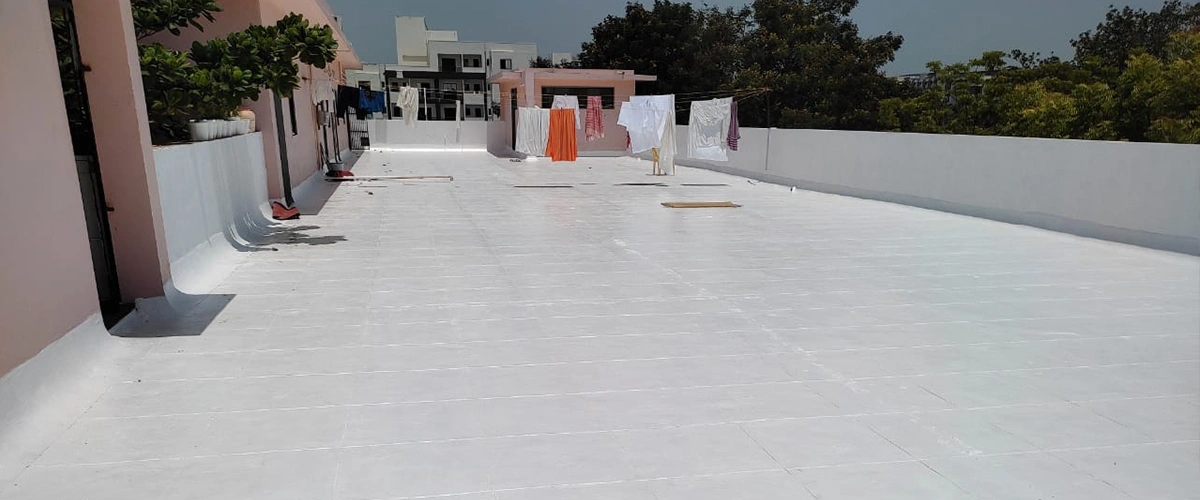
As a reference point, a CRRC-rated reflective system such as Panache Green’s CoolTops Premium carries an SRI of 109, with 87% solar reflectance and 0.86 emissivity, translating to above-deck surface temperature reductions of 18 to 20°C on cement and concrete substrates and 20 to 25°C on metal roofing, with indoor temperature reductions in the 4 to 8°C range. These are the categories of data you should be requesting from any vendor, not just this one.
Elongation and Crack-Bridging for Waterproofing
Waterproofing membranes get evaluated on a different set of criteria: elongation at break, crack-bridging ability and UV resistance. A membrane that cannot stretch and recover as a substrate moves with thermal cycling will eventually crack, and a compromised membrane undermines the life-cycle performance that green building assessments care about. Ask for elongation percentages and accelerated weathering data, not just a warranty period.
Which IGBC and LEED Credit Categories Do Envelope Materials Affect?
Envelope specification touches more rating categories than most architects initially assume. Under both IGBC and LEED, Sustainable Sites credits reward reduced heat-island effect from roof and paving surfaces, which is where high-SRI roofing and reflective pervious pavers earn points directly. Energy & Atmosphere credits reward improved building energy performance relative to a baseline, and reflective roofing combined with thermal insulation changes the cooling load your energy model has to account for, sometimes meaningfully. Materials & Resources categories look at recycled content and regional sourcing. And Water Efficiency or stormwater-related credits reward permeable paving that reduces runoff rather than channeling it into municipal drains.
The practical implication: a single envelope decision, say, which roofing system you specify, can influence your Sustainable Sites score, your energy model, and your maintenance and durability narrative simultaneously. That’s why LEED compliant products need to come with documentation the vendor can actually hand to your sustainability consultant, not just a product sheet designed for retail buyers.
Building the Envelope as One System, Not Four Purchases
Cooling, insulation, waterproofing and pervious paving each address a distinct physical mechanism. Reflective coatings manage radiative heat gain at the surface. Thermal insulation manages conductive heat transfer through the building fabric. Waterproofing manages moisture ingress and the structural degradation that follows it. Pervious paving manages surface runoff and the paved-area contribution to site-level heat-island effect. Because these are different mechanisms, they are often specified together on green building projects rather than treated as substitutes for one another.
Sequencing matters here. Waterproofing should be assessed and specified first, since a roof or wall system with underlying moisture issues will compromise whatever reflective or insulating layer sits above it. Insulation and reflective cooling layers are then specified together where the building envelope allows, since one addresses conductive load and the other addresses radiative load, and neither substitutes for the other in an energy model. Pervious paving decisions for the site typically run in parallel, since they’re governed more by stormwater and landscape planning than by roof-level sequencing.
This is the strategic argument for treating green building products for architects as an integrated envelope system: specifying from a single vendor relationship that spans all four categories reduces interface risk between products, simplifies warranty accountability, and gives your sustainability consultant one source of documentation instead of four. Panache Green’s portfolio is structured around exactly this logic, spanning CoolTops cooling systems, Insulmix thermal insulation, FAP and FASC waterproofing systems, and Reflective Perco Pavers under one brand, precisely so an architect isn’t reconciling test data from four separate suppliers with four separate testing methodologies.
Vendor Credentials as a Risk-Reduction Filter
Specification risk isn’t only about the product. It’s about whether the vendor can support you through the credit submission and post-occupancy verification process. A CRRC founding membership indicates a vendor’s products go through independent testing and rating rather than in-house claims alone. IGBC leadership involvement, such as Panache Green founder Neetu Jain’s role as Chairperson of the IGBC Vadodara Chapter, indicates a working familiarity with how credits are actually documented and defended, not just how products are marketed. For an architect, these credentials function as a due-diligence shortcut: they narrow the field to vendors whose data will hold up under a rating body’s review, which matters far more once your project is mid-submission than it does at the initial product comparison stage.
 Get Free Audits
 Get Free Quote