What is the difference in thermal insulation & Reflective coatings
Cool Roof Coatings

Every April, a familiar search pattern spikes across Indian cities: “how to cool roof in summer.” It shows up on Google Trends in Ahmedabad, Nagpur, Hyderabad and Delhi weeks before the pre-monsoon heat peaks, and it is not a seasonal curiosity. It reflects a structural problem in how Indian cities are built. Dense concentrations of concrete, asphalt and metal sheet roofing absorb solar radiation all day and release it slowly through the evening, keeping ambient temperatures elevated well after sunset. Urban planners call this the Urban Heat Island (UHI) effect, and it is now measurable, mapped and, in some states, regulated.

This article explains the building science behind roof cooling, why India’s climate makes the problem particularly acute, how state and city policy is responding, and what to look for when evaluating a cool roof coating rather than relying on marketing claims.

Why Roofs Overheat in Indian Cities

A conventional RCC (reinforced cement concrete) roof or a bare metal sheet has low solar reflectance and moderate to low thermal emittance. In plain terms: it absorbs most of the sunlight that hits it and struggles to release that absorbed energy efficiently. On a clear pre-monsoon afternoon in central or western India, roof surface temperatures on dark, unprotected concrete or metal routinely climb well above ambient air temperature. That heat conducts through the roof deck into occupied space below, forcing HVAC systems to work harder, or, in uncooled buildings such as many warehouses and low-income homes, pushing indoor temperatures to levels that affect health, productivity and equipment performance.

India’s geography compounds this. Most of the country sits at latitudes that receive intense, near-vertical solar radiation for extended periods, and the pre-monsoon window (March to June) combines high solar load with low cloud cover and minimal rainfall relief. Add rapid vertical urbanization, where thousands of low-albedo RCC roofs sit close together radiating heat back into the same airshed, and you get city-wide temperature elevation that a single air conditioner cannot solve. This is precisely why how to cool roof in summer has moved from a niche construction question to a mainstream public health and infrastructure concern.

The Policy Response: Cool Roofs Are No Longer Optional

Indian regulators have started treating roof reflectance as building infrastructure, not aesthetic choice. Telangana’s Cool Roof Policy (2023-2028) is the country’s first state-wide mandate of its kind. It requires cool roofs on all government and non-residential or commercial buildings, and on residential plots of 600 square yards or more, enforced through the building permit and occupancy certificate process. The policy targets 30 square kilometres of cool roof coverage by 2024-25, scaling to 300 square kilometres by 2028, with 200 square kilometres concentrated in Hyderabad alone. The projected impact at full scale: roughly 600 million kWh of electricity saved annually and about 30 million tonnes of CO2 offset cumulatively.

Independent research supporting the policy estimates that cool roofs lower indoor temperatures by approximately 2.1 to 4.3 degrees Celsius compared with conventional roofing, a range consistent with what building scientists observe when solar heat gain at the roof surface is reduced. Ahmedabad’s Heat Action Plan, active since 2013 and widely cited as a model for heat-wave preparedness, has promoted reflective and cool roofing as a mitigation measure well before Telangana formalized its mandate. Hyderabad, Bhopal, Nagpur and several other municipal bodies now reference cool roofing in their own heat action frameworks. The direction is consistent: cool roof coating India adoption is shifting from voluntary sustainability initiative to a compliance and public-health requirement.

The Building Science: SRI, Reflectance and Emittance

To evaluate any solar reflective coating, it helps to understand the metric that governs it: the Solar Reflectance Index, or SRI. SRI combines two separate physical properties into a single 0-100+ scale. The first is solar reflectance, the fraction of incoming solar radiation, including the near-infrared spectrum that carries much of the sun’s heat energy, that a surface reflects rather than absorbs. The second is thermal emittance, how efficiently a surface releases whatever heat it does absorb, rather than retaining it and conducting it into the building below. The Cool Roof Rating Council (CRRC) is the reference body that tests and certifies both properties for roofing products, giving specifiers a standardized, independent basis for comparison rather than relying on a manufacturer’s own claims.

A high SRI coating works through two mechanisms simultaneously. It reflects a large share of incoming solar energy before it ever becomes heat at the roof surface, and it re-emits whatever energy is absorbed quickly enough that the deck itself stays cooler. This is mechanically distinct from thermal insulation, which does not reduce how much heat the surface absorbs but instead slows the rate at which absorbed heat conducts through the roof’s mass into occupied space. The two approaches are complementary: reflectance and emittance address the surface, insulation addresses the pathway. A building envelope strategy that accounts for both performs better than either alone, particularly in India’s uninsulated RCC roofing stock.

Why This Matters More in India Than in Temperate Climates

Countries with temperate climates and shorter, milder summers see cool roofing largely as an energy-efficiency add-on. India’s situation is structurally different. Extended pre-monsoon heat, high-intensity solar radiation, dense low-albedo urban construction and a large stock of uninsulated metal and RCC roofing (warehouses, industrial sheds, mid-rise residential blocks) combine to make roof cooling a load-bearing part of thermal comfort, energy demand management and, increasingly, occupant safety during heat waves. For facility managers running warehouses and industrial roofs, the calculation is direct: lower roof surface temperature reduces conductive heat gain, which reduces cooling load, which reduces electricity consumption, often meaningfully enough to shift the economics of solar PV installed on the same roof, since panel efficiency itself degrades as ambient roof temperature rises.

Evaluating a Cool Roof Coating: What to Check Before You Specify

Marketing language around thermal coatings is common; independently verified data is not always. Before specifying a cool roof coating for a warehouse, institutional building, hospital or residential project, four checks are worth applying.

  • Independent SRI and reflectance data. Ask whether the reflectance, emittance and SRI figures are CRRC-tested or equivalent, not internally generated.

  • Documented before-and-after thermal performance. Thermal imaging and surface temperature data from real installations, not laboratory conditions alone, indicate how a coating performs on actual Indian roofs.

  • System, not single SKU. A roof envelope involves substrate preparation, waterproofing continuity and coating application together. A coating applied over an unaddressed waterproofing issue will not deliver its rated performance for long.

  • Organizational credibility. Membership in bodies such as CRRC or IGBC signals a manufacturer’s investment in independent testing standards rather than self-reported claims.

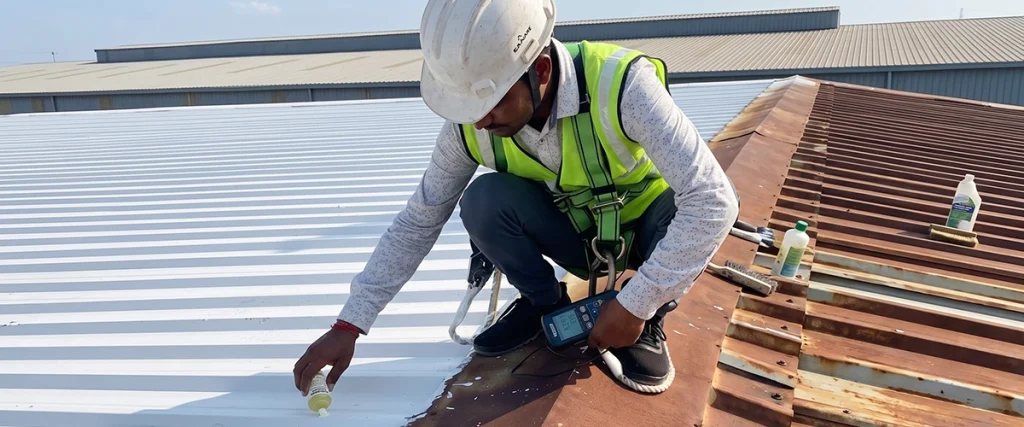
Panache Green, headquartered in Vadodara and founded in 2011, is a CRRC founding member, a distinction that reflects direct involvement in setting the testing standards the industry now references. The company’s CoolTops Premium system is CRRC-rated with a Solar Reflectance Index of 109, solar reflectance of 87 percent and thermal emittance of 0.86. Documented above-deck surface temperature reductions run 18-20°C on cement and concrete substrates and 20-25°C on metal roofing, translating to indoor temperature reductions of 4-8°C and a potential annual cooling energy reduction of 5-30 percent, alongside a reported 10-25 percent solar PV efficiency gain where panels sit on a cooled roof surface. It is applied as a three-product, five-coat system rather than a single layer, which is consistent with the substrate-plus-coating logic above.

What differentiates Panache Green from single-product coating suppliers is scope. Rather than selling reflective coating in isolation, the company operates across cooling, thermal insulation, waterproofing and pervious paving as an integrated building envelope offering, drawing on more than 15 years of project experience, over 50,000 clients and projects, and more than 50 lakh square feet of CoolTops coverage delivered to date. That combination matters because roof failures in India are rarely caused by one factor alone; heat gain, water ingress and insulation gaps typically compound each other, and treating them as a single system tends to outperform treating them as separate purchases.

Closing the Loop: From Policy to Practice

Telangana’s mandate is unlikely to remain an outlier. As heat-wave mortality data accumulates and more Heat Action Plans formalize roofing requirements, cool roof compliance is likely to extend well beyond government buildings into commercial, institutional and eventually residential construction across additional states. For architects, consultants and facility managers specifying roofing today, the practical question is no longer whether to plan for roof cooling, but which system delivers verifiable, tested performance over the building’s operating life rather than a marketing claim on a data sheet.

Frequently Asked Questions

Waterproofing paint is engineered primarily to block water ingress and may or may not have meaningful solar reflectance. A cool roof coating is formulated and independently tested for high solar reflectance and thermal emittance (expressed as SRI), specifically to reduce roof surface temperature and conductive heat gain. Some systems, including integrated envelope systems, address both functions, but they are not the same performance category by default.

Independent research cited in Telangana’s Cool Roof Policy documentation estimates indoor temperature reductions of roughly 2.1 to 4.3°C compared with conventional roofing. CRRC-rated systems such as Panache Green’s CoolTops Premium report indoor reductions of 4-8°C, alongside above-deck surface temperature drops of 18-25°C depending on the substrate, reflecting differences in SRI rating, application quality and roof type.

Yes. Telangana’s Cool Roof Policy (2023-2028) mandates cool roofs on government buildings, non-residential and commercial buildings, and residential plots of 600 square yards or more, enforced through the building permit and occupancy certificate process. Several other cities, including Ahmedabad and Hyderabad, promote or require reflective roofing through municipal Heat Action Plans even without a formal state mandate.

Solar Reflectance Index (SRI) is a standardized 0-100+ scale combining solar reflectance and thermal emittance into one number, tested by bodies such as the Cool Roof Rating Council (CRRC). Asking for CRRC-verified SRI data, rather than accepting a manufacturer’s unverified percentage claims, is the single most reliable way to compare coatings on actual measured performance.

No. Reflective coatings reduce how much solar heat the roof surface absorbs in the first place, while thermal insulation slows the conduction of any absorbed heat through the roof’s mass into occupied space. The two mechanisms address different points in the heat transfer pathway and typically perform best together, particularly on India’s largely uninsulated RCC and metal roofing stock.

If you are evaluating roof cooling for a warehouse, institutional facility, hospital or large residential project, Panache Green’s technical team can walk through CRRC test data, documented case performance and substrate-specific recommendations for your building. Reach out to discuss which envelope system fits your project’s climate zone and roof type.

Benefits Of Choosing Panache’s Green Rated Products:

Our Partnership Programs

Our Partner

Cross complemented product and services providers can be enrolled under this partnership program (Roofing contractor, HVAC contractors, HVLS Fans supplier)

Know More Our Partner
Our Partner

Any individual from consultation fraternity to execution contractors can participate in such a program.

Know More Our Partner
Our Partner

DSA (Direct selling Agent) partnership program provides opportunities to become entrepreneur in COOL ROOFING industries to each and every individual who wants to make their career as freelancers.

Know More Our Partner
Our Partner

We provide platforms for applicators to become certified Cool Roof Professionals.

Know More Our Partner

Green Talk Initiatives

Green Talk Initiatives

Check out all our videos on GreenTalk here.

Partner with Panache Now !

Our Affiliations

We are associated with the leading organizations in India and abroad and are in constant engagement with them to further their efforts on environmental sustainability for our planet.

cii ciigreenpro environdec fgiindia vccivadodara bni grihaindia igbc coolroofs warehousing rotary cept DCL

Client Success Stories