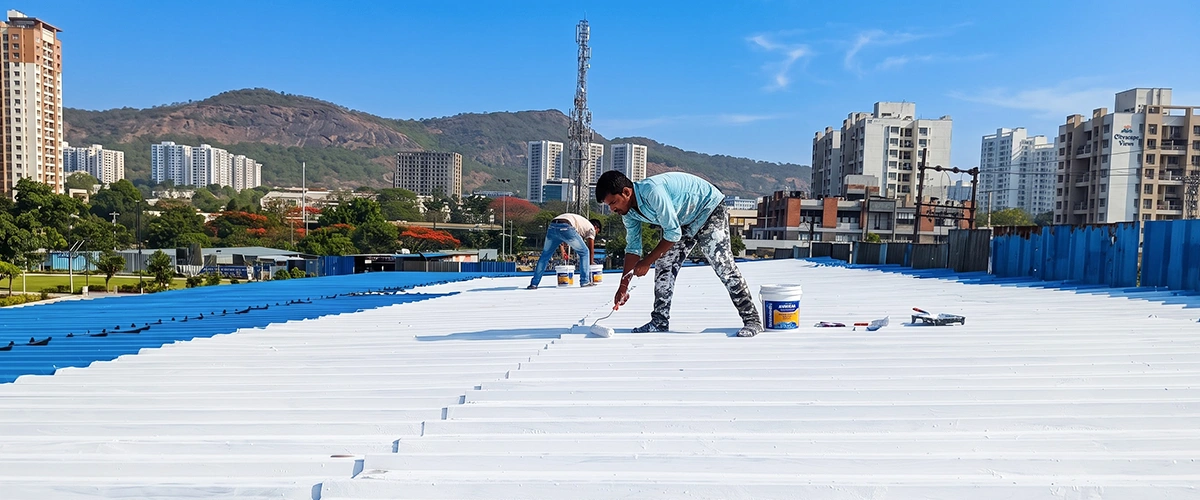
On a flat RCC roof, the screed is the layer laid over the slab to create slope for drainage. A conventional screed adds weight but no insulation. A roof screed insulation system replaces it with a lightweight, low conductivity layer that does the same job while also reducing the heat that passes through the roof. Insulmix Roof Screed from Panache is made from sealed expanded clay, expanded microspheres and minerals, and is designed for use in cooling dominated climates. This guide explains how roof screed insulation works and how it fits with cool roof coating and waterproofing.
Insulation, cooling and waterproofing for a complete roof system
Insulmix is the Panache thermal insulation range, with a roof screed, a wall plaster and an insulated wall texture. On the roof, insulation performs well when it is combined with a reflective coating above and a waterproofing layer. See thermal insulation and the Insulmix Roof Screed page.
Thermal insulation is a construction material with low thermal conductivity, often less than 0.1 W/mK. In a roof, that means the slab underneath sees a smaller temperature swing, and less heat reaches the rooms below.
Insulmix is built on lightweight cellular aggregate. When microspheres and clay are heated rapidly to a high temperature, the water in them vaporises instantly, and the material expands 20 to 40 times its original volume. The trapped air in this structure is what resists heat flow. Because the aggregate is light, the screed can be laid to slope without adding the load of a conventional screed.
Its expansion behaviour under heat is compatible with the roof, which prevents cracks from forming as the roof warms and cools. Roof screed insulation also provides some acoustic insulation.
A common sequence on an RCC roof is the slab, the insulation screed laid to slope, a waterproofing layer, and a reflective coating on top. Each layer has a different job. The coating reflects solar radiation, the waterproofing keeps water out, and the screed slows the heat that gets through.
The roof is the surface most exposed to the sun. At an ambient temperature of 45 °C, a cement roof surface reaches 65 to 70 °C and a metal surface 80 °C. On the top floor of a building, that heat is felt directly, and air conditioners work hardest there.
Roof insulation reduces AC consumption and energy costs, lowers CO2 emissions and increases thermal comfort. It also reduces the heat the building releases into the surroundings, so it contributes to the mitigation of the Urban Heat Island effect.
Insulation and cool roof coatings complement each other. A reflective coating, such as cool roof paint, keeps the surface up to 20 to 28 °C cooler, and the screed reduces the conduction of the heat that remains. This combination suits projects that pursue IGBC, GRIHA and LEED certification.
Carbon Footprint: Calculate your carbon footprint through an easy-to-use calculator.
Cool Roof Energy Saving: Understand how you use and can save energy in your company, office or house.
Cost Calculator: Find out how much it will cost you to make your premises environmentally sustainable.
RCC roofs of residential, commercial, institutional and green buildings.
Walls where Insulmix Wall Plaster is used along with roof insulation.
IGBC, GRIHA and LEED certified projects in cooling dominated climates.
Thermal insulation screed for roofs.
A cooling and waterproofing system that goes over the insulated roof.
Panache thermal insulation products are Green Pro and GRIHA certified, and EPD certification is in process. Panache products reduce power costs, CO2 emissions and GHG emissions, and improve thermal comfort, health benefits and the indoor environment.
Share the roof area, building type and location to receive a quotation for roof screed insulation.
Water Proofing: roof, foundation and structure waterproofing.
Thermal Insulation: the full Insulmix range.
Water Repellents / Sealants: protection for masonry and exterior walls.
Metal Care: protective treatments for metal surfaces.
Wood Care: protective treatments for wooden surfaces.
The surface of an insulated roof still needs to be reflective. A cool roof coating consists of a binder, usually organic or silicone, blended with pigments and additives. It protects the roof membrane and reflects solar radiation to lower air conditioning cost.
The main components are the binder, pigments, reflective pigments and water. Water is the liquid carrier, and most white coatings are water based.
The Panache white reflective elastomeric coating can reflect up to 92 percent of visible light and keeps the roof much cooler than aluminium, black or non-reflective roofing. It lowers energy use, adds years to the roof and avoids costly tear-offs and re-roofing.
We are associated with the leading organizations in India and abroad and are in constant engagement with them to further their efforts on environmental sustainability for our planet.











 Get Free Audits
 Get Free Quote