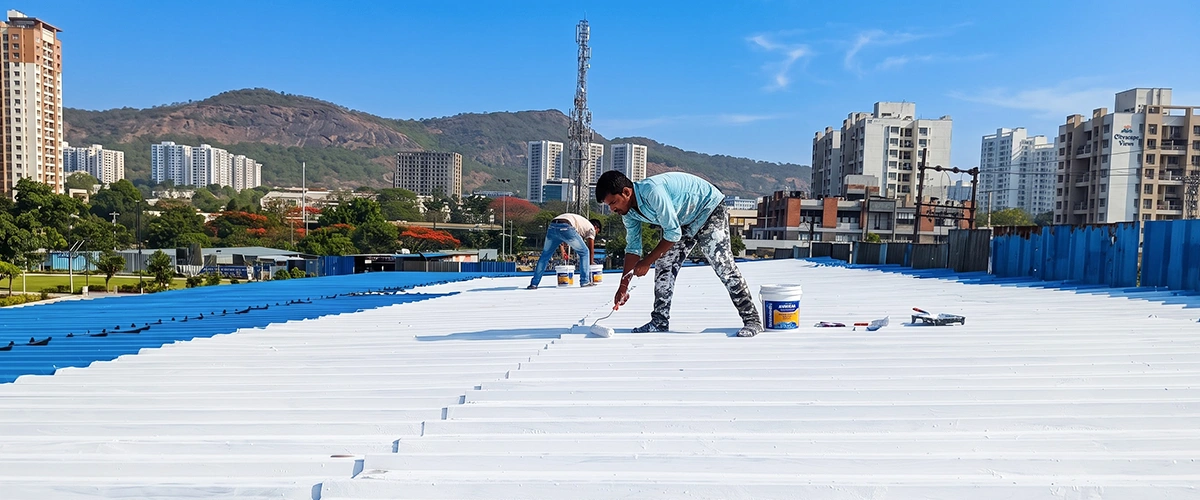
Heat enters a building through its roof, its walls and the paved areas around it. The most effective way to reduce it is to work on the envelope, so that less heat gets in to begin with. Building heat reduction solutions combine reflection at the surface, resistance inside the roof and wall assembly, and protection from moisture that would reduce that resistance. Panache offers all three: high SRI cool roof coatings, thermal insulation and waterproofing, backed by Green Pro and GRIHA certified products.
Reflective coatings, insulation and waterproofing for the roof, walls and surroundings
The Panache high SRI range is a Green Pro certified system of coatings and paints for roofs, walls, pavements, cycle tracks, driveways and roads. It works on NIR reflection technology and nanotechnology to reduce the generation of heat and its ingress indoors. Insulation and waterproofing complete the approach. Related pages: cool roof paint, thermal insulation and reflecting coatings.
Heat moves into a building by radiation, conduction and convection. On a sunny day, radiation is the trigger. Almost 58 to 60 percent of solar radiation is infrared, and a conventional surface absorbs it and heats to 60 to 75 °C. That heat is then conducted through the roof or wall and warms the indoor air.
The first step is to stop absorption. A high SRI coating reflects infrared radiation and has high thermal emittance, so it radiates away the heat it holds. Roofs stay up to 20 to 28 °C cooler and walls up to 10 °C cooler than conventional materials in peak summer.
The second step is to resist what is left. Thermal insulation is a material with low thermal conductivity, often less than 0.1 W/mK. Insulmix insulation uses sealed expanded clay, expanded microspheres and minerals to slow the conduction of heat through roofs and walls.
The third step is to keep the assembly dry, because moisture raises conductivity and damages materials. Waterproofing and water repellents protect the envelope so that its heat performance is retained.
Surface temperatures in built up areas can reach 70 °C. At an ambient temperature of 45 °C, a metal roof can reach 80 °C and a cement roof 65 to 70 °C. Heat accumulates in the structure during the day and is released at night, so interiors stay warm when outside air has cooled.
The response is usually more air conditioning, which is the largest source of electricity use in many buildings. Reducing heat at the envelope reduces cooling load, peak power demand and greenhouse gas emissions from power plants.
Passive heat reduction also helps the city. Buildings that reflect and release less heat reduce the Urban Heat Island effect, cool the outside air and improve air quality by slowing smog forming reactions. It is the combination of reflection and insulation that gives the most stable comfort indoors.
Carbon Footprint: Calculate your carbon footprint through an easy-to-use calculator.
Cool Roof Energy Saving: Understand how you use and can save energy in your company, office or house.
Cost Calculator: Find out how much it will cost you to make your premises environmentally sustainable.
RCC roofs, metal sheets, tanks and pipelines of residential, commercial and industrial buildings.
Roads, pathways, driveways and cycle tracks around buildings.
Sun facing exterior walls, using high SRI systems and insulation plaster.
Cooltops Premium and Cooltops Classic for roof heat reduction.
A cooling and waterproofing system for roofs.
All Panache products are Green Pro and GRIHA certified. EPD certification and CRRC certification for the high SRI cooling range are in process. Panache products reduce power costs, CO2 emissions and GHG emissions, and improve thermal comfort, health benefits, product quality and the indoor environment.
Share your building type, roof and wall details, and the Panache team will recommend a heat reduction approach and a quotation.
Water Proofing: roof, foundation and structure waterproofing.
Thermal Insulation: Insulmix roof screed, wall plaster and wall texture.
Water Repellents / Sealants: protection for masonry and exterior walls.
Metal Care: protective treatments for metal surfaces.
Wood Care: protective treatments for wooden surfaces.
A cool roof coating has a binder, usually organic or silicone, mixed with pigments and additives. It protects the roof membrane for a longer life cycle and reflects solar radiation to lower air conditioning cost.
The main components are the binder, pigments, reflective pigments and water. Water is the liquid carrier, and most white coatings are water based.
The Panache white reflective elastomeric coating can reflect up to 92 percent of visible light and keeps the roof much cooler than aluminium, black or non-reflective roofing. It lowers energy use, adds years to the roof and avoids costly tear-offs and re-roofing.
We are associated with the leading organizations in India and abroad and are in constant engagement with them to further their efforts on environmental sustainability for our planet.











 Get Free Audits
 Get Free Quote